React vs Next.js: What Should Developers Choose in 2026?
A side‑by‑side comparison of React and Next.js in 2026, covering performance, SEO, developer experience, and ecosystem to help you pick the right tool for your next project.
Introduction
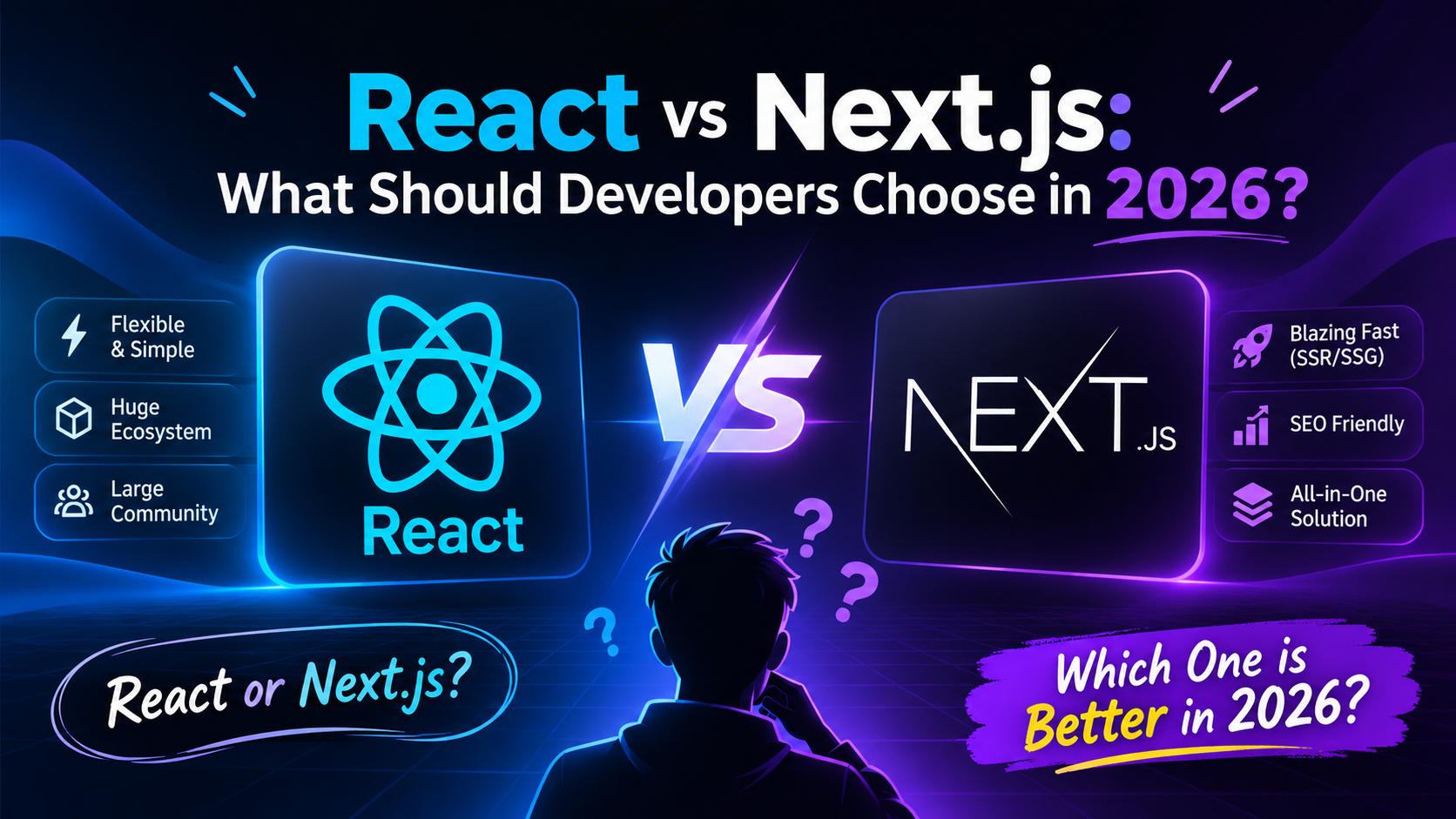
React has been the de‑facto library for building user interfaces for over a decade, while Next.js has evolved from a simple server‑rendered add‑on to a full‑stack framework. As of 2026 both are mature, but they serve different goals. This article breaks down the most relevant criteria—performance, SEO, routing, developer experience, and ecosystem—to help you decide which one aligns with your project requirements.
Understanding React
React is a UI library that lets you compose components using JSX. It provides a virtual DOM, a declarative rendering model, and a rich ecosystem of third‑party tools. React itself does not prescribe routing, data fetching, or server‑side rendering; developers choose libraries such as React Router, Redux, or SWR to fill those gaps.
Understanding Next.js
Next.js is a framework built on top of React. It adds conventions for file‑based routing, server‑side rendering (SSR), static site generation (SSG), API routes, and built‑in image optimization. In 2026 the platform also includes Edge Functions, Incremental Static Regeneration (ISR) with sub‑second updates, and first‑class TypeScript support.
Key Comparison Criteria
Performance
Both React and Next.js benefit from React 19’s concurrent features, but Next.js can deliver faster first‑paint times out of the box thanks to automatic static optimization and edge caching. For a pure client‑side app that never needs SSR, a vanilla React setup with a bundler like Vite can be equally performant.
Search Engine Optimization (SEO)
SEO is where Next.js shines. By rendering pages on the server or at build time, search crawlers receive fully populated HTML. React‑only apps rely on client‑side rendering, which can be mitigated with prerendering tools, but the solution is less seamless.
Routing & Data Fetching
React requires third‑party routers (e.g., React Router) and data‑fetching libraries (e.g., React Query). Next.js provides a file‑system router and built‑in data‑fetching methods (getStaticProps, getServerSideProps, fetch in server components). This reduces boilerplate and enforces a clear separation between static and dynamic content.
Developer Experience
React gives you full freedom to assemble your stack, which can be empowering for seasoned engineers but adds decision fatigue. Next.js offers sensible defaults, hot‑module replacement, and automatic TypeScript configuration, leading to a smoother onboarding experience for junior developers.
Ecosystem & Community
Both benefit from a massive community, but Next.js has a tighter integration with Vercel’s deployment platform and a growing marketplace of plugins (e.g., next‑auth, next‑image). React’s ecosystem is broader, offering more specialized state‑management solutions and UI libraries.
Deployment & Hosting
React apps can be hosted on any static‑file CDN, while Next.js apps often leverage Vercel or Netlify for edge functions, ISR, and serverless API routes. If you need server‑side capabilities without managing infrastructure, Next.js provides a one‑click path.
Practical Use Cases
Content‑heavy marketing site: Choose Next.js for static generation and built‑in SEO.
Complex SaaS dashboard: React with a custom state‑management stack (e.g., Redux Toolkit) gives you granular control over client‑side interactions.
E‑commerce platform with personalized pricing: Next.js ISR allows you to update product pages in seconds while keeping the performance of static pages.
Real‑time collaborative app: A pure React setup paired with WebSocket libraries (e.g., Socket.io) can keep the client logic lightweight.
Decision Guidance
Use the following checklist to narrow your choice:
Do you need out‑of‑the‑box SEO and server‑side rendering? → Next.js
Is the project a single‑page application with heavy client‑side interactivity? → React
Do you prefer minimal configuration and fast onboarding? → Next.js
Do you have strict performance budgets for first‑contentful paint? → Evaluate both; Next.js static pages often win.
Conclusion
React remains the foundational UI library, offering unmatched flexibility for custom stacks. Next.js builds on that foundation, delivering conventions that accelerate development, improve SEO, and simplify deployment. In 2026 the right choice hinges on your project’s rendering needs, team expertise, and time‑to‑market constraints. When in doubt, start with Next.js—it gives you React’s power plus a production‑ready framework, and you can always strip away features if you outgrow them.