How to Become a Professional AI/ML Engineer: A Step‑by‑Step Guide
A practical roadmap for transitioning into AI/ML engineering, covering education, core skills, project experience, and career‑building strategies.
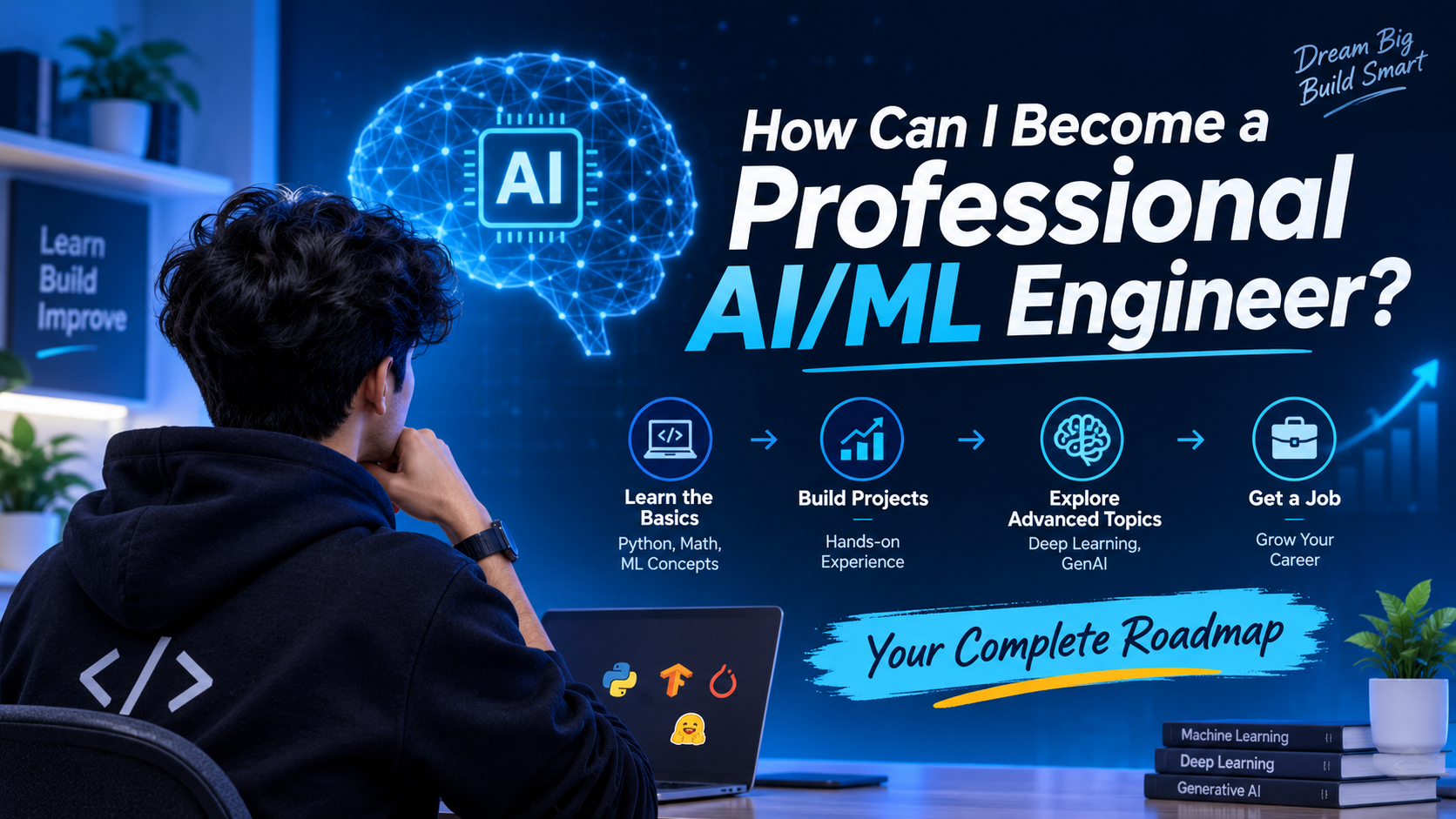
Artificial intelligence and machine learning are no longer niche research areas; they are core components of products, services, and decision‑making across industries. If you are passionate about data, algorithms, and building intelligent systems, a career as an AI/ML engineer can be both rewarding and lucrative. This guide outlines a clear, actionable path from beginner to professional, highlighting the education, skills, and experiences that employers value.
1. Build a Strong Foundation in Mathematics and Programming
AI/ML relies heavily on linear algebra, probability, statistics, and calculus. Without a solid grasp of these concepts, it is difficult to understand how models work or to troubleshoot them.
Linear Algebra: vectors, matrices, eigenvalues, and singular value decomposition.
Probability & Statistics: distributions, hypothesis testing, Bayesian reasoning.
Calculus: gradients, partial derivatives, and optimization basics.
Simultaneously, become proficient in at least one programming language used in the field—most professionals choose Python because of its extensive libraries (NumPy, pandas, scikit‑learn, PyTorch, TensorFlow). A good practice is to complete a small project, such as implementing gradient descent from scratch, to cement both math and coding skills.
2. Master Core Machine‑Learning Concepts
Once the fundamentals are in place, focus on the algorithms and pipelines that power real‑world AI solutions.
Supervised Learning: linear regression, logistic regression, decision trees, ensemble methods (Random Forest, XGBoost).
Unsupervised Learning: k‑means clustering, principal component analysis, autoencoders.
Deep Learning: neural network architectures, convolutional networks for images, recurrent/transformer models for sequences.
Model Evaluation & Deployment: cross‑validation, ROC/AUC, model serving with Flask/FastAPI, monitoring drift.
Online courses such as Andrew Ng’s Machine Learning and the Deep Learning Specialization provide structured curricula and hands‑on notebooks.
3. Gain Hands‑On Experience with Real Projects
Employers look for evidence that you can translate theory into production‑ready solutions. Choose projects that showcase end‑to‑end pipelines:
Predictive maintenance for a manufacturing dataset (data cleaning → feature engineering → model training → API deployment).
Image classification for a public health initiative using transfer learning.
Natural‑language sentiment analysis on social‑media streams, integrated with a dashboard.
Document each step on GitHub, write a concise README, and include visualizations of results. Open‑source contributions to libraries like scikit‑learn or PyTorch can further demonstrate collaborative skills.
The best way to predict the future is to build it. – Alan Kay
4. Create a Portfolio That Shows Impact
A well‑curated portfolio does more than list projects; it tells a story about the problem, your approach, and the measurable outcome.
Project page: brief problem statement, data source, key metrics, and a link to the code repository.
Blog posts or notebooks: explain concepts you struggled with; teaching reinforces mastery.
Performance metrics: include baseline vs. final model scores, and, when possible, business impact (e.g., “reduced churn by 12%”).
Host the portfolio on a personal domain (e.g., yourname.com) and ensure it’s mobile‑friendly and searchable.
5. Navigate the Job Market and Continue Learning
With a solid portfolio, you can target roles such as Machine Learning Engineer, Data Scientist, or AI Research Engineer. Follow these steps:
Tailor your resume: highlight relevant coursework, projects, and tools (TensorFlow, Docker, Kubernetes).
Network: attend meetups, webinars, and conferences (NeurIPS, ICML, local AI groups). A brief LinkedIn message referencing a shared interest can open doors.
Prepare for interviews: practice coding on platforms like LeetCode, and review ML system design questions (e.g., “How would you design a recommendation engine at scale?”).
Stay current: subscribe to newsletters (Import AI, The Batch), read arXiv preprints, and experiment with emerging models such as diffusion or large language models.
Remember that AI/ML is a rapidly evolving field; continuous learning is part of the job description.
Conclusion
Becoming a professional AI/ML engineer is a disciplined journey that blends mathematical rigor, software engineering, and domain‑specific problem solving. By building a strong theoretical base, mastering core algorithms, delivering end‑to‑end projects, and presenting a compelling portfolio, you position yourself for success in a competitive market. Start with small, measurable steps, iterate on feedback, and let curiosity drive your growth—your future as an AI/ML engineer begins today.