How the Internet Actually Works Behind the Scenes
A clear, step‑by‑step look at the core technologies—DNS, TCP/IP, routing, and data packets—that keep the web running every second of every day.
Introduction
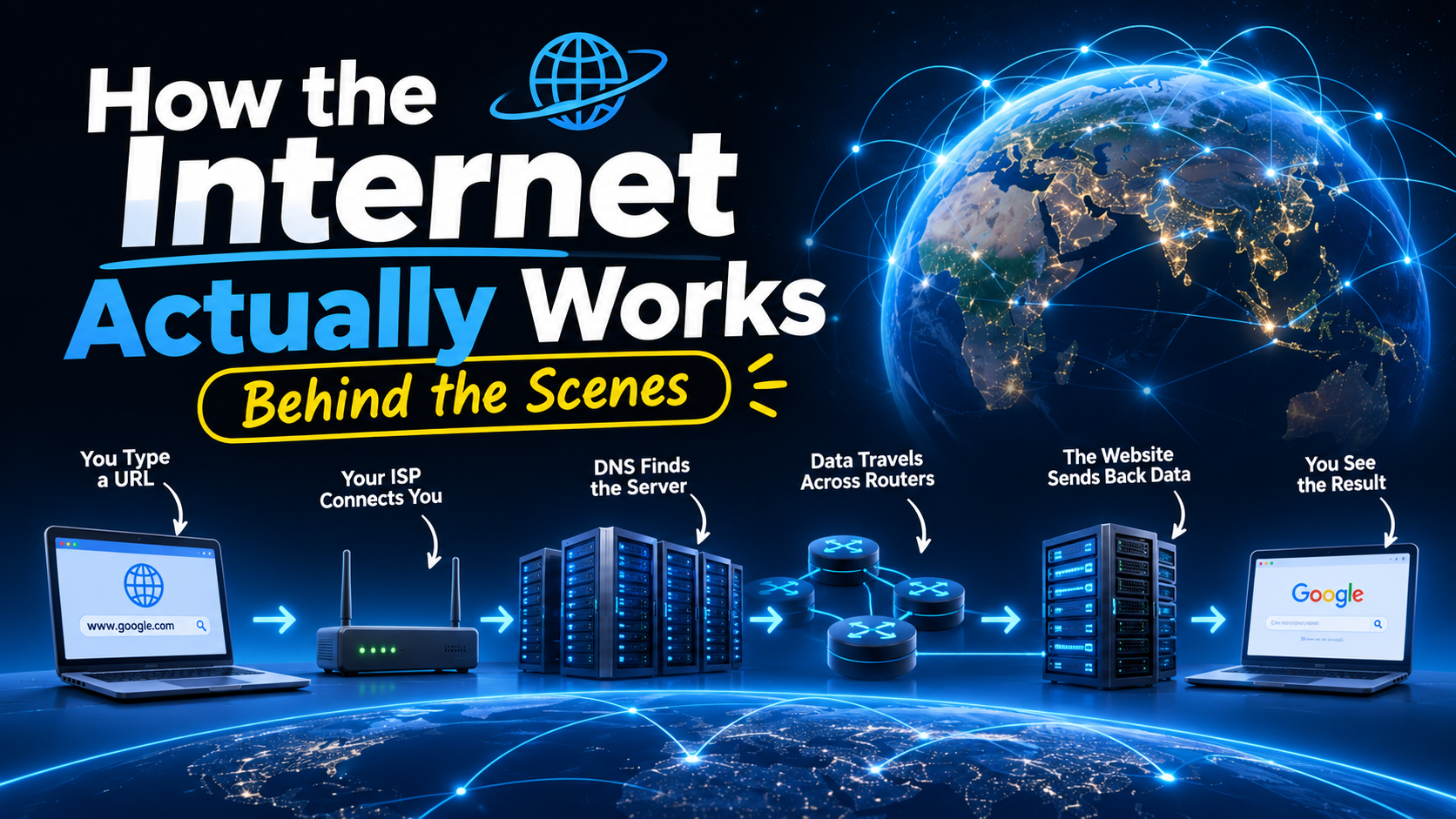
When you type a URL into a browser, a complex chain of processes unfolds in milliseconds. Understanding these mechanisms demystifies why a page loads quickly, why it sometimes stalls, and how security and reliability are built into the system.
1. From Human‑Readable Names to Numeric Addresses
The journey begins with the Domain Name System (DNS). DNS translates the domain you entered (e.g., example.com) into an IP address that computers use to locate each other on the network.
Recursive resolver: Your ISP’s DNS server receives the query and either answers from its cache or forwards the request up the hierarchy.
Root servers: The resolver contacts one of the 13 root servers, which point it to the appropriate top‑level domain (TLD) server (.com, .org, etc.).
Authoritative server: Finally, the TLD server directs the resolver to the domain’s authoritative name server, which returns the IP address.
Because DNS responses are cached at multiple levels, subsequent visits to the same site are faster.
2. Breaking Data into Packets
Once the IP address is known, the browser establishes a connection using the Transmission Control Protocol (TCP). TCP ensures reliable, ordered delivery of data by dividing the information into packets and reassembling them at the destination.
Three‑way handshake: The client sends a SYN packet, the server replies with SYN‑ACK, and the client finishes with ACK. This establishes a stable session.
Segmentation: Large files (HTML, images, scripts) are split into manageable packet sizes, each carrying a sequence number.
Acknowledgment: The receiver confirms receipt of each packet; missing packets are retransmitted.
This process guarantees that even if some packets are lost or arrive out of order, the final content is reconstructed correctly.
3. Routing the Packets Across the Globe
Each packet travels independently through a series of routers. Routers use the packet’s destination IP address and consult routing tables to decide the next hop.
Key routing concepts include:
Shortest‑path algorithms: Protocols like OSPF and BGP calculate efficient routes based on metrics such as hop count, latency, and policy.
Autonomous Systems (AS): Large networks (ISPs, corporations) are grouped into ASes, each announcing reachable IP prefixes to neighboring ASes via BGP.
Redundancy: Multiple paths exist, so if one link fails, packets are rerouted automatically.
The result is that a single webpage may be assembled from packets that took different physical routes.
4. Securing the Connection
Modern browsers default to HTTPS, which adds a layer of encryption using the TLS protocol. TLS works atop TCP and provides:
Authentication: The server presents a digital certificate verified by a trusted Certificate Authority.
Encryption: A symmetric session key, negotiated during the TLS handshake, encrypts all subsequent data.
Integrity: Message Authentication Codes (MACs) ensure data isn’t altered in transit.
Because TLS runs after the TCP handshake, the underlying packet delivery mechanisms remain unchanged, but the payload is protected.
5. Rendering the Page on Your Device
After the encrypted packets are decrypted, the browser parses the HTML, CSS, and JavaScript. It may request additional resources (images, fonts) using separate HTTP/2 or HTTP/3 streams, which multiplex multiple requests over a single TCP connection, reducing latency.
Finally, the rendering engine constructs the Document Object Model (DOM) and paints the visual representation on your screen.
Conclusion
The internet’s seamless experience is the result of layered protocols, distributed caching, and robust routing. From DNS lookups to packet segmentation, from BGP routing decisions to TLS encryption, each component plays a precise role. Knowing how these pieces fit together not only satisfies curiosity but also empowers developers and users to troubleshoot issues, optimize performance, and appreciate the engineering marvel that connects the world.