How Large Language Models Work: Inside the Tech Behind ChatGPT
A clear, step‑by‑step look at the architecture, training process, and deployment of large language models, plus the practical limits and ethical concerns they bring.
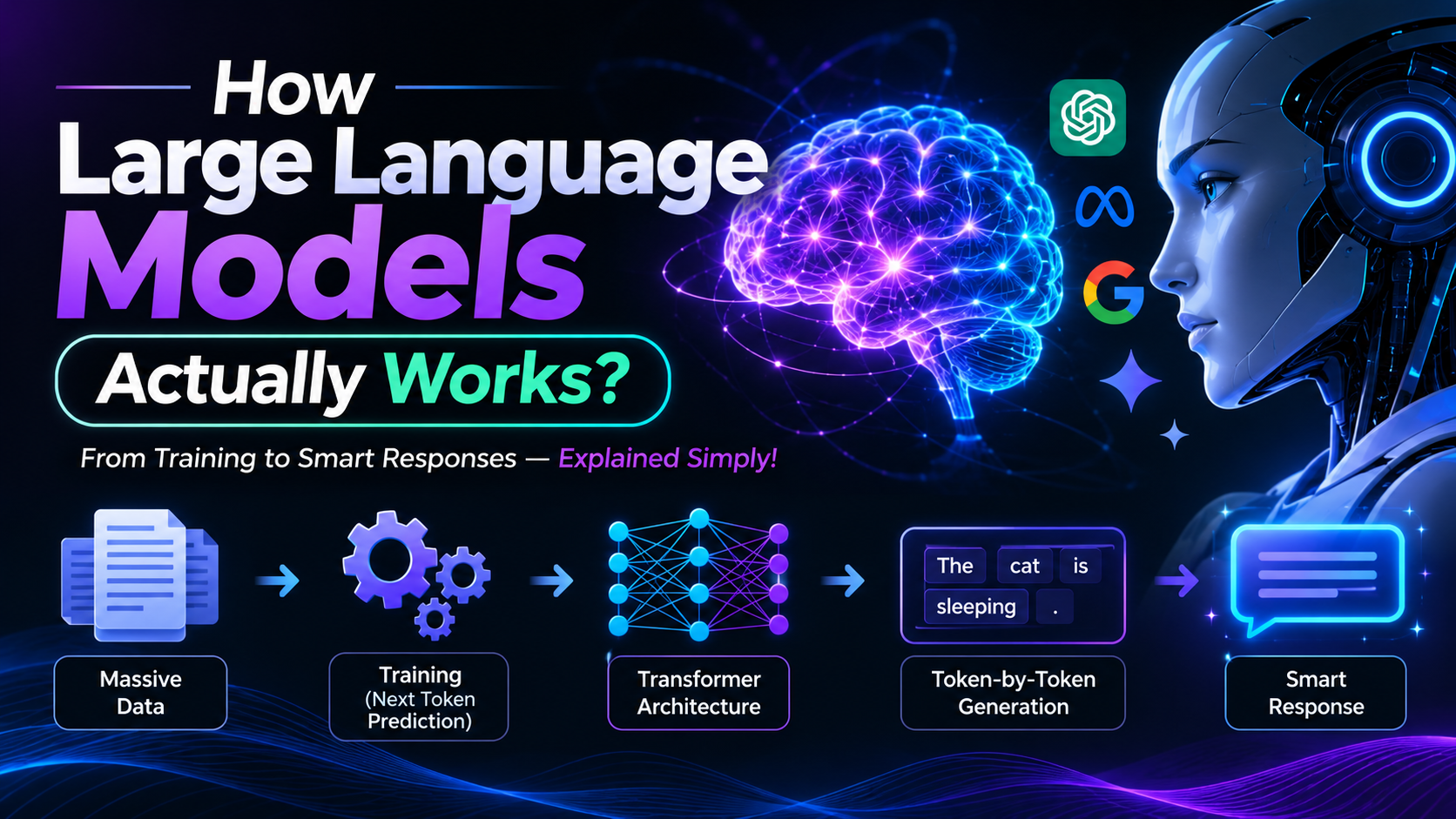
Large language models (LLMs) such as ChatGPT have moved from research curiosities to everyday tools. Yet many users still wonder what happens under the hood. This article breaks down the key components—architecture, training, fine‑tuning, and inference—while highlighting common misconceptions and real‑world constraints.
The Core Architecture: Transformers
Since the 2017 paper Attention Is All You Need, the transformer has become the standard building block for LLMs. Unlike recurrent networks, transformers process entire sequences in parallel, using a mechanism called self‑attention to weigh the relevance of each token to every other token.
In practice, a transformer layer consists of:
Multi‑head self‑attention, which captures different relational patterns simultaneously.
Feed‑forward neural networks that transform the attended information.
Layer normalization and residual connections that stabilize training.
Stacking dozens or even hundreds of these layers yields the deep models that power modern LLMs.
Training at Scale: Data and Compute
Training an LLM is essentially a massive next‑token prediction task. The model sees billions of words and learns to assign higher probability to the token that actually follows a given context.
Data collection
Data is scraped from publicly available sources—web pages, books, forums, and code repositories. Quality filtering removes low‑quality or duplicated text, but the sheer volume remains in the terabyte range.
Compute resources
Training requires specialized hardware, typically clusters of GPUs or custom AI accelerators. Distributed training frameworks split the model and data across many devices, allowing parallel gradient updates.
Because the loss surface is high‑dimensional, researchers use optimizers like Adam and techniques such as learning‑rate warm‑up and cosine decay to reach a stable solution.
Fine‑Tuning and Instruction Following
After pre‑training, models are often fine‑tuned on narrower datasets to specialize them. Two common approaches are:
Supervised fine‑tuning: The model learns from example input‑output pairs, aligning its responses with desired behavior.
Reinforcement learning from human feedback (RLHF): Human evaluators rank model outputs, and a reward model translates these rankings into a signal that guides further training.
RLHF is a key factor behind ChatGPT’s ability to follow instructions and produce helpful answers.
Inference and Deployment
During inference, the model generates text token by token. Several tricks keep latency low:
Beam search or nucleus sampling balances quality and diversity.
Quantization reduces the precision of weights, cutting memory usage.
Model parallelism splits the model across multiple servers for very large versions.
APIs expose the model behind a simple HTTP endpoint, allowing developers to integrate LLM capabilities into their applications.
Common Misconceptions
Despite the hype, LLMs do not possess understanding or intent. They are statistical pattern matchers that excel at producing plausible continuations of text. This explains why they can generate fluent prose yet still make factual errors.
Limitations and Ethical Considerations
Key limitations include:
Hallucination: The model may fabricate details that sound convincing.
Bias: Training data reflects societal biases, which can surface in outputs.
Resource intensity: Training and running large models consume significant energy, raising sustainability concerns.
Addressing these issues requires ongoing research, transparent reporting, and responsible deployment practices.
Conclusion
Large language models combine the transformer architecture, massive data, and powerful compute to predict text. Fine‑tuning and RLHF turn raw prediction ability into useful, instruction‑following behavior. Understanding the underlying mechanics helps set realistic expectations and guides responsible use as the technology continues to evolve.