How Artificial Intelligence Works: A Clear Guide
A concise, professional overview of the core principles behind artificial intelligence, from machine learning basics to real‑world applications and ethical challenges.
Introduction
Artificial intelligence (AI) refers to systems that can perform tasks typically requiring human intelligence, such as recognizing patterns, making decisions, and learning from experience. This article breaks down the technical building blocks that enable AI to function.
Fundamental Concepts
Machine Learning
Machine learning (ML) is a subset of AI that focuses on algorithms that improve automatically through exposure to data. Instead of being explicitly programmed for every scenario, ML models infer rules from examples.
Neural Networks
Inspired by the human brain, neural networks consist of layers of interconnected neurons that transform inputs into outputs. Deep learning, a branch of ML, uses many layers to capture complex patterns.
Data and Training
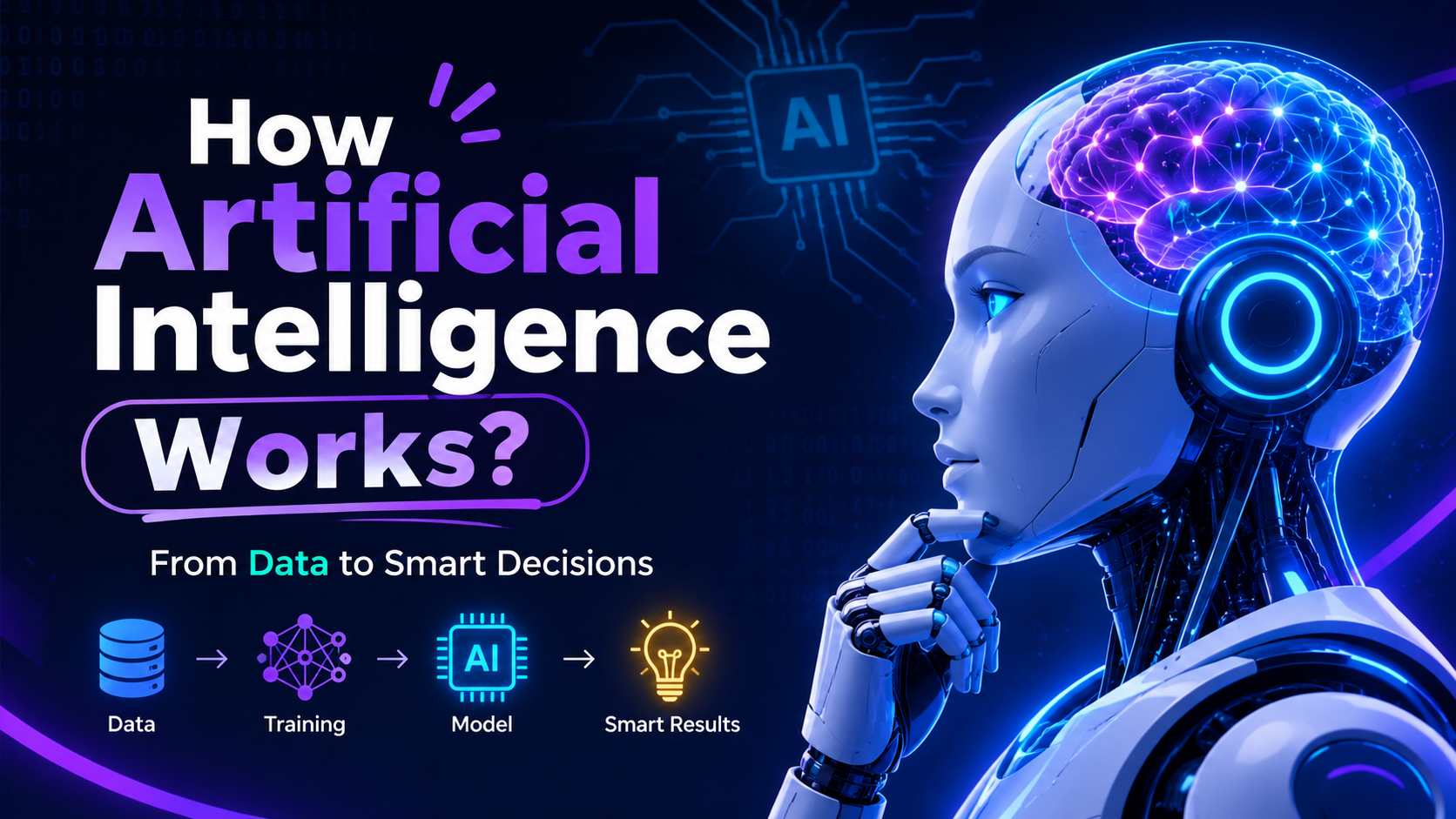
High‑quality, labeled data is the fuel for most AI systems. During training, the model adjusts its internal parameters to minimize the difference between its predictions and the known outcomes.
Key Techniques
Supervised Learning
In supervised learning, the model is trained on input‑output pairs. For example, a spam filter learns to classify emails by analyzing messages labeled as “spam” or “not spam.”
Unsupervised Learning
Unsupervised learning discovers hidden structures in data without explicit labels. Clustering algorithms, such as k‑means, group similar items together, which is useful for market segmentation.
Reinforcement Learning
Reinforcement learning (RL) trains agents to make sequences of decisions by rewarding desirable actions. AlphaGo’s victory over human champions showcased RL’s potential.
Practical Example: Image Classification
Consider a model that identifies animals in photos. The workflow typically includes:
Collecting a labeled dataset of animal images.
Choosing a convolutional neural network (CNN) architecture.
Training the CNN on the dataset, adjusting weights to reduce classification error.
Evaluating performance on a separate test set and fine‑tuning as needed.
After training, the model can predict the animal in a new image with high confidence.
Challenges and Ethical Considerations
AI systems face technical hurdles such as bias in training data, interpretability, and scalability. Ethically, developers must address privacy concerns, potential job displacement, and the risk of unintended consequences.
“Artificial intelligence is the new electricity.” – Andrew Ng
Conclusion
Understanding how AI works demystifies the technology and highlights both its capabilities and its responsibilities. By mastering the core concepts of data, algorithms, and model evaluation, professionals can build intelligent solutions that are both effective and ethical.