Building the Future Through Technology
Software engineering is more than writing code. It is the systematic process of designing, developing, testing, and maintaining reliable software solutions that solve real-world problems.
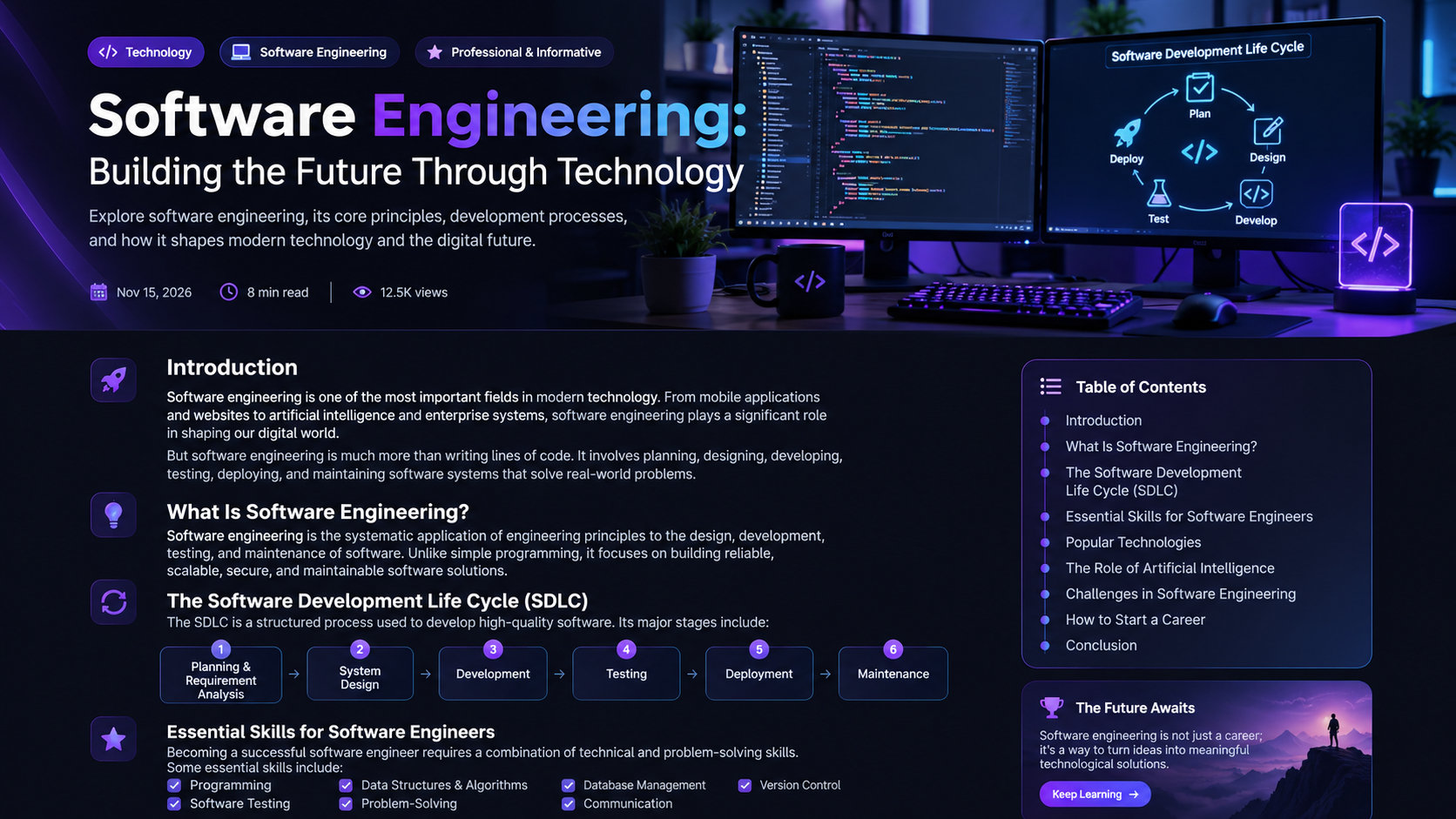
Software Engineering: Building the Future Through Technology
Introduction
Software engineering is one of the most important fields in modern technology. From mobile applications and websites to artificial intelligence and enterprise systems, software engineering plays a significant role in shaping our digital world.
But software engineering is much more than writing lines of code. It involves planning, designing, developing, testing, deploying, and maintaining software systems that solve real-world problems.
As technology continues to evolve, the demand for skilled software engineers is growing across almost every industry.
What Is Software Engineering?
Software engineering is the systematic application of engineering principles to the design, development, testing, and maintenance of software.
Unlike simple programming, software engineering focuses on building reliable, scalable, secure, and maintainable software solutions.
A software engineer considers not only how software works but also how it performs, how users interact with it, and how easily it can be improved in the future.
The Software Development Life Cycle (SDLC)
The Software Development Life Cycle (SDLC) is a structured process used to develop high-quality software.
Some of its major stages include:
1. Planning and Requirement Analysis
Understanding the project's objectives, identifying user requirements, and determining the resources needed.
2. System Design
Creating the architecture, database structure, user interface, and technical specifications.
3. Development
Writing code using appropriate programming languages, frameworks, and development tools.
4. Testing
Identifying bugs, checking functionality, and ensuring the software meets its requirements.
5. Deployment
Making the software available to users through production environments.
6. Maintenance
Monitoring performance, fixing issues, improving security, and introducing new features.
Essential Skills for Software Engineers
Becoming a successful software engineer requires a combination of technical and problem-solving skills.
Some essential skills include:
Programming: Knowledge of languages such as JavaScript, Python, Java, and C++.
Data Structures and Algorithms: Understanding efficient ways to organize and process information.
Database Management: Working with databases such as MongoDB, PostgreSQL, and MySQL.
Version Control: Using Git and GitHub to manage code and collaborate with others.
Software Testing: Writing and executing tests to improve software reliability.
Problem-Solving: Analyzing complex challenges and developing effective solutions.
Communication: Working effectively with developers, designers, and other team members.
Popular Technologies in Software Engineering
The software engineering industry uses a wide range of technologies.
Some popular examples include:
Frontend Development: React.js, Next.js, HTML, CSS, and JavaScript.
Backend Development: Node.js, Express.js, Python, and Java.
Database Technologies: MongoDB, PostgreSQL, and MySQL.
Cloud Computing: AWS, Microsoft Azure, and Google Cloud.
DevOps: Docker, Kubernetes, and CI/CD pipelines.
Artificial Intelligence: Machine Learning, Deep Learning, and AI-powered applications.
These technologies help engineers build modern applications that are efficient, scalable, and user-friendly.
The Role of Artificial Intelligence in Software Engineering
Artificial Intelligence is transforming how software is developed.
AI-powered tools can assist developers with code generation, debugging, documentation, and automated testing.
However, AI does not eliminate the need for software engineers. Human judgment, architectural decisions, security awareness, creativity, and critical thinking remain essential.
The most effective approach is to use AI as a productivity tool while maintaining a strong understanding of software engineering fundamentals.
Challenges in Software Engineering
Software engineers face several challenges throughout the development process.
Some common challenges include:
Managing complex software systems.
Maintaining application security.
Improving performance and scalability.
Fixing unexpected bugs.
Working with changing requirements.
Keeping up with rapidly evolving technologies.
Solving these challenges requires continuous learning, careful planning, and effective engineering practices.
How to Start a Career in Software Engineering
For beginners interested in software engineering, building a strong foundation is essential.
Here are some practical steps:
Learn programming fundamentals.
Understand data structures and algorithms.
Choose a development path, such as frontend, backend, or mobile development.
Learn database management and version control.
Build real-world projects.
Practice problem-solving regularly.
Collaborate with other developers and contribute to open-source projects.
Practical experience and continuous improvement are valuable parts of becoming a capable software engineer.
Conclusion
Software engineering is not simply about creating applications; it is about solving problems through technology.
As the digital world continues to expand, software engineers will remain important contributors to innovation across industries.
Whether you are interested in web development, mobile applications, artificial intelligence, or cloud computing, learning software engineering can open doors to exciting opportunities.
The future belongs to those who can turn ideas into meaningful technological solutions.